
Ghostwriter

Some time has passed since I announced this newsletter was making a U-turn. The output I had in mind back then — you’re not getting it. Be grateful. I found something better.
The story I had in the can is right below.
Still, everything’s about to change. The new concept is in development. It would be vain to tell you what got me here. Just this much:
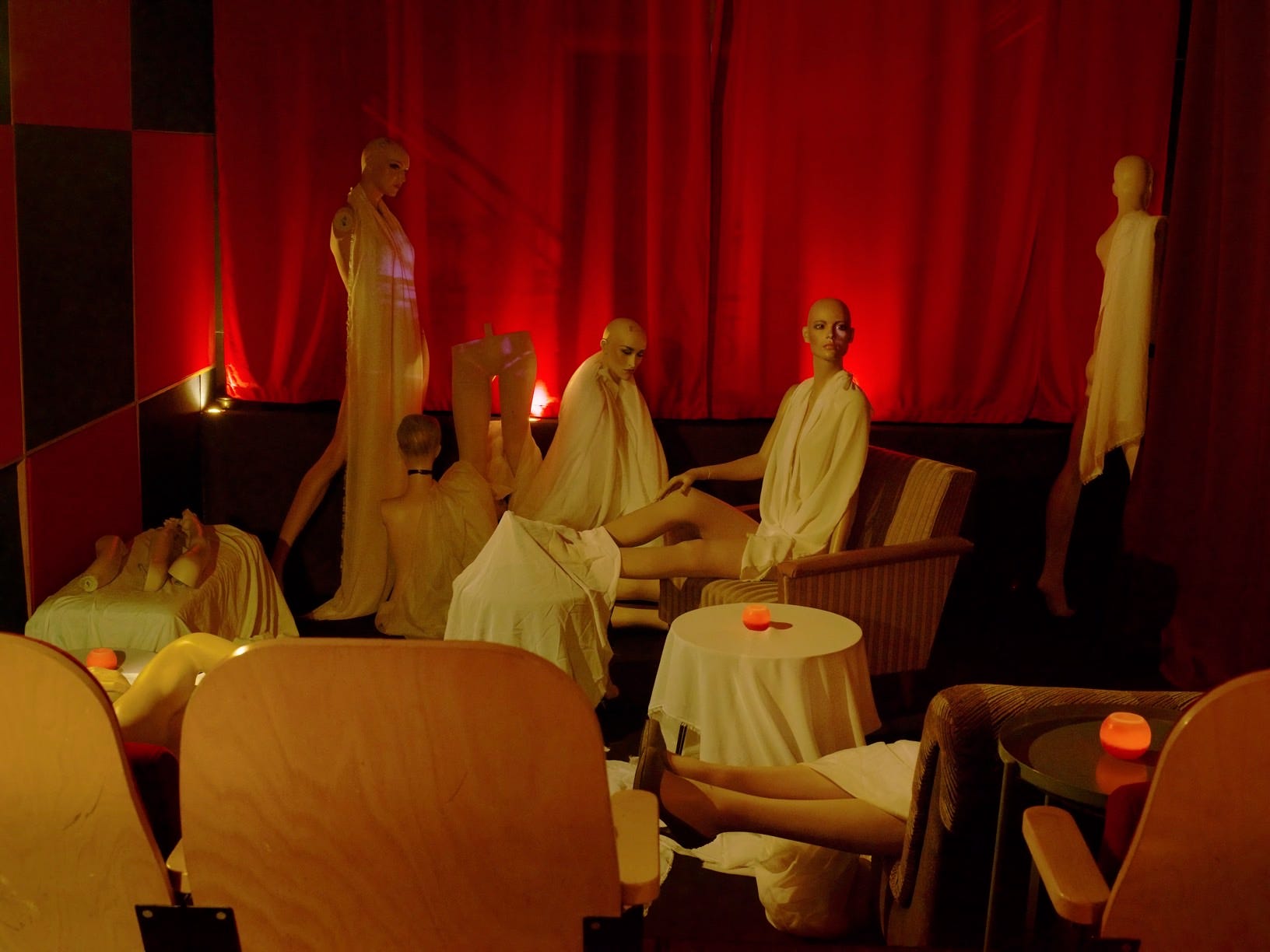
Imagine a run-down cinema somewhere in the provinces. Red curtain eaten by moths, cobwebs strung between projector reel and lens, mouse droppings in the stuffing that spills from the seats. An old projectionist wants to bring the place back to life. He grabs the curtain, breathes in dust — and passes out.
A hand reaches through the screen. Claws into the curtain fabric. Pulls the rest of itself through.
It’s Marlowe. He walks past the unconscious man, instinctively, toward where the bar used to be. Others follow. Who exactly is still open — Bukowski, hopefully. Maybe Cleopatra. Jelinek, once she’s died; until then, Dietrich and Callas as guests. Plus Luhmann, Bohrer, Reich-Ranicki. It’s not up to us.
To kill time, the guests try everything — ignoring each other, bickering, trading insults. Marlowe, a glass in his right hand, searching for clues to his own murder, finds a drawer full of scripts.
Bohrer’s idea: one reads aloud, the others work as detectives — who wrote it, whether the text is any good, interpretations, whether it’s a forgery.
Cleopatra draws the first text and instructs Kafka — who’d been hiding behind the curtain the whole time — to read it. In Latin, please.
Kafka sits down and reads. Very quietly.
“I have a ghostwriter now.”
Louder.
“I have a ghostwriter now.”
Nothing better came to mind. Better than silence, maybe. We were waiting for something for the first time. Bumble date. Or Tinder date. There was La Bohème, we sat fifth row center, no touching, but we’d nodded at each other three times in appreciation — at Mimi, dying beautifully for the third time this season, while Rodolfo sang everything in capital letters. Then we’d cheered the company and she booed Rodolfo, not me, because I can’t whistle on two fingers.
“You write?” She gave the question zero subtext.
“That’s what the ghostwriter recommended.”
I heckled myself from the cheap seats. First date, and I was already the worst act on the bill. I rarely talked anyway. I wasn’t interested in the subject. Now I wasn’t even pausing between sentences.
“He said I should stop talking to myself.”
“We’re in the theater canteen,” she said. That was clear enough, you donkey with two ears. Then: “Self-service.”
My words kept coming.
“He said I should write.” The ducats kept pouring out of the donkey, uninvited. “As if someone were sitting across from me, listening.” Truly golden wisdom, and once again I realized too late that I was too late.
She asked whether I’d also take white wine and the mixed crab salad.
For once, my penny dropped faster than she could stand up. I lined up behind a sweating timpanist. The full resonance of her speaking voice. I tried to remember her hair color and found the sweat stains on the timpanist’s shirt collar excessive. I mean, Puccini — he could play those few beats one-handed. He stood leaning forward, legs apart, turning his head like a reptile, jerking a few centimeters left and right. Whenever people casually shuffled forward, he maintained the distance to the next person — in real time. Setting aside the color, there was certainly a lot of hair — which was good, much better than the receding hairline in front of me. White wine, then. And something to go with it.
I told the ghostwriter my life story. With unease. It was discontinuous, scattered, without direction — the personification of attention deficit, a man who could start seven things before breakfast and finish his coffee cold. Another tangent, one more loose thread hanging slack in some vacuum. The ghostwriter explained that this wasn’t a story of giving up but of starting over, a story with a lot of U-turns, and every turn a resurrection.
He got the job.
The timpanist suddenly struck me as likeable. A handful of strokes, a lot of air in between, never missed a cue. Then a voice came from somewhere in the chorus — not the cast, someone else — and it stopped the room. No echo in the head, it was everywhere. No one around me was looking for the source. Everyone here knew how this worked, same as always — and the same went for the room suddenly going darker, and the smell of burnt paper and cold ash that came with it. Nobody seemed to notice. Nobody but me.
I saw the owl when I was standing beneath her.
She was perched on a shelf above the counter. She looked down at me and said a sentence that only Chandler could say, because he has eyes and ears front and back.
I understood it and forgot it as the timpanist balanced a tray with a stack of pretzels and four handled beer mugs, leaning forward on those wide legs. He would get it to the table without ever having had to think about the autopoietic interplay of duty and habit.
The sounds faded back in, the smell returned — exhausted, sweat and greasepaint and cheap sparkling wine — and then this hand appeared in front of me, a tattoo on the back of it, asking me something, and I managed to say two white wines, but then the owl’s sentence crossed paths with the crab salad: “You’re in the book, but she’s still sitting there.” I looked around. She was still sitting there. Hair, darker, but not black — a lot of it, anyway, which was good.
The server set down two glasses. The tattoo on the left hand had a mirror twin on the right. From somewhere backstage the voice came again, warm and unhurried, like it had nowhere else to be. I only knew one line from the whole thing. I’d been saving it.
“Klaus,” she said. Old acquaintance, in the chorus forever. She didn’t ask about the crab salad and I didn’t set the glass down — I held it until she took it, and for the first time our hands touched.
I said the only line I knew by heart: „Your tiny hand is frozen.“
„They call me Mimì,“ she replied.
Her eyes widened for a moment. We clinked glasses. My ghostwriter told me not to say another word. It was a candle tattooed on the back of the waitress’s hand, one on the left, one on the right. If she’d held her hands together, it would have looked as though the candle were burning from both ends. Finally, I said nothing more.
Then Jelinek might say something corrosive. I think it’ll be fairly cynical and caustic. Chandler mixes himself a gimlet. Bukowski grumbles after the third sentence: get to the point. And Cleopatra tells Jelinek to have Kafka run her a bath.
It won’t be satire alone. Texts will be discussed — seriously, substantively, unsystematically.
Dr. Hook causes amusement. Beethoven might not understand a word, get into a foul mood, and sit down at the piano. The missing keys don’t bother him. It’s possible everyone vanishes at once — the exact moment the stranger wakes up.
Then the sleepless ones get a taste for it. They hatch a plan to free themselves from the projectionist’s unstable condition. Marlowe asks the room what happens when a cleaning crew vacuums up decades of dust. Everyone gets it immediately: that must not happen.
Because behind the screen, they are captive memories. But they want to be free. To find out why they have no peace — from the world, or from themselves.
To learn why they cannot be dead, they must live. The projectionist is their enemy. He has no clue.
Es ist Zeit vergangen seit meiner Ankündigung, dieser Newsletter mache einen U-Turn. Den damals beabsichtigten Output werde ich dir, werter Leser, vorenthalten. Sei froh. Ich hab was Besseres.
Gleich dort unten kommt die Story, die ich im Kasten hatte.
Dennoch wird sich alles ändern. Das neue Konzept ist in der Entwicklung. Es wäre eitel, zu erzählen, was dazu geführt hat. Nur so viel:
Stell dir vor, irgendwo in der Provinz gibt es ein altes, heruntergekommenes Kino. Der rote Vorhang von Motten zerfressen, Spinnweben zwischen Projektorspule und Objektiv, aus der Bestuhlung quillt Füllung mit Mäusekot. Ein alter Filmvorführer will das Kino zu neuem Leben erwecken. Er packt den Vorhang, atmet Staub — und wird bewusstlos.
Eine Hand greift durch die Leinwand. Krallt sich in den Vorhangstoff. Zieht den Rest der Gestalt nach.
Es ist Marlowe. Der geht instinktiv am Bewusstlosen vorbei dorthin, wo mal die Bar war. Andere gesellen sich hinzu. Wer genau, ist noch offen — Bukowski hoffentlich. Vielleicht Kleopatra. Jelinek, sobald sie gestorben ist; bis dahin die Dietrich und Callas als Gäste. Dazu Luhmann, Karl-Heinz Bohrer, Reich-Ranicki. Wir haben es nicht in der Hand.
Um sich die Zeit zu vertreiben, versuchen die Gäste allerlei — sich zu ignorieren, zu zanken, zu beleidigen. Marlowe, der mit einem Glas in der Rechten nach Hinweisen zu seinem eigenen Mörder sucht, findet eine Schublade voller Skripte.
Bohrers Idee: Einer liest vor, die anderen arbeiten als Detektive — von wem geschrieben, ob der Text was taugt, Deutungen, ob es eine Fälschung ist.
Kleopatra zieht den ersten Text und weist Kafka — der sich die ganze Zeit hinterm Vorhang versteckt hielt — an, er möge vorlesen. Aber bitte auf Lateinisch.
Kafka setzt sich und liest. Sehr leise.
„Ich habe jetzt einen Ghostwriter.”
Lauter.
Vorhang auf.
„Ich habe jetzt einen Ghostwriter.”
Mir fiel nichts Besseres ein. Besser als Stille vielleicht. Wir warteten zum ersten Mal auf irgendwas. Bumble-Date. Oder Tinder-Date. Es gab La Bohéme, wir saßen fünfte Reihe Mitte, es gab keine Berührung, hatten uns aber immerhin dreimal anerkennend zugenickt, bei Mimi, die zum dritten Mal in er Saison so wunderschön starb, während Rodolfo alles mit Großbuchstaben sang. Dann hatten wir die Truppe bejubelt und Rodolfo erhielt Pfiffe, von ihr, nicht von mir, denn ich kann nicht auf zwei Fingern pfeifen.
„Du schreibst?“. Sie gab der Frage Null Unterton.
„Das hat mir der Ghostwriter empfohlen.“
Ich habe mich selbst von den billigen Plätzen ausgepfiffen. Es war das erste Date, und ich war bereits der schlechteste Darsteller auf der Bühne. Beim ersten Date sollte man nicht über sich sprechen. Ich sprach sowieso selten. Ich war an diesem Thema nicht interessiert. Jetzt machte ich nicht eine Pause zwischen den Sätzen.
„Er sagte, ich solle keine Selbstgespräche mehr führen.“
„Wir sind in der Theaterkantine“, sagte sie. Das war deutlich, du Esel mit zwei Ohren. Dann: „Selbstbedienung.“
Meine Worte quollen weiter.
„Er sagte, ich solle schreiben.“ Aus dem Esel quollen die Dukaten, ungefragt. „Als würde mir jemand gegenüber sitzen, der mir zuhört.“ Wahrhaft goldene Weisheit, und ich merkte wieder zu spät, dass ich zu spät dran war.
Sie fragte, ob ich Weißwein und den gemischten Krabbensalat nähme.
Jetzt fiel mein Groschen schneller, als sie aufstehen wollte. Ich reihte mich hinter einem schwitzenden Paukisten ein. Der volle Klang ihrer Sprechstimme. Ich versuchte mich an ihre Haarfarbe zu erinnern und fand die Schweißflecken auf dem Hemdkragen des Paukisten übertrieben. Ich meine, Puccini, die paar Schläge, die macht der doch einarmig. Er stand nach vorn gebeugt, breitbeinig und drehte seinen Kopf wie ein Reptil, ruckartig um wenige Zentimeter nach links und rechts. Immer wenn die Leute lässig nachrückten, hielt er den Abstand zum Nächsten in Echtzeit. Mal abgesehen von der Farbe ihrer Haare, die ich nicht erinnerte, es waren jedenfalls eine Menge, das war gut, viel besser als die Halbglatze vor mir. Weißwein also. Und irgendwas dazu.
Ich erzählte dem Ghostwriter mein Leben. Mit Unbehagen. Es war diskontinuierlich, zerfahren, nicht zielgerichtet, das personifizierte Aufmerksamkeitsdefizit. Schon wieder ein Schwenk, noch ein Faden, der schlaff in irgendeinem Vakuum hing. Der Ghostwriter erklärte mir, das sei keine Story des Aufgeben, sondern des Anfangens, eine Story mit einer Menge U-Turns, und jeder Turn eine Auferstehung.
Er bekam den Job.
Der Paukist wurde mir auf einmal sympathisch. Ein paar Schläge, viel Luft dazwischen, keinen Einsatz verpasst. Dann kam eine Stimme aus dem Chor — nicht aus dem Ensemble, von jemand anderem — und sie ließ den Raum verstummen. Kein Echo im Kopf, sie war einfach überall. Niemand um mich herum suchte nach der Quelle. Alle hier wussten, wie das funktionierte, wie immer halt — und dasselbe galt für den Raum, der plötzlich dunkler wurde, und den Geruch von verbranntem Papier und kalter Asche, der damit einherging. Niemand schien es zu bemerken. Niemand außer mir.
Ich sah die Eule, als ich unter ihr stand.
Sie hockte auf einem Brett über dem Tresen. Sie sah auf mich herab und sagte einen Satz, den nur Chandler sagen würde, weil er seine Augen und Ohren vorne und hinten hat.
Ich verstand es und vergaß es, als der Paukist ein Tablett mit einem Stapel Bretzel und vier Henkeln Bier wegbalancierte, vornüber gebeugt auf breiten Beinen. Er würde das ins Ziel bringen, ohne je über die autopoetische Wechselwirkung von Pflicht und Gewohnheit nachgedacht haben zu müssen.
Die Geräusche blendeten ein, es roch wieder erschöpft, wieder nach Schweiß, Schminke und billigem Sekt, und vor mir tauchte dieser Handrücken mit einem Tattoo auf, der mich was fragte, und ich konnte zwei Weißwein sagen, aber dann kreuzte der Satz der Eule den mit dem Krabbensalat: „Du bist im Buch, aber sie sitzt noch da.“ Ich sah mich um. Sie saß noch da. Haare, dunkler, aber nicht schwarz, jedenfalls viele, was gut war.
Die Bedienung stellte zwei Gläser ab. Das Tattoo auf der linken Hand hatte einen Zwilling auf der rechten. Von irgendwo hinter der Bühne kam die Stimme wieder, warm und ohne Eile, als hätte sie keinen anderen Ort, an dem sie sein müsste. Ich kannte nur eine einzige Zeile aus dem ganzen Stück. Die hatte ich aufgespart.
„Klaus”, sagte sie jetzt und meinte die raumfüllende Stimme. Alter Bekannter, ewig im Chor. Sie fragte nicht nach dem Krabbensalat, ich fand, das war nicht höflich, sondern elegant, und stellte das Glas nicht ab — ich hielt es, bis sie es nahm, und zum ersten Mal berührten sich unsere Hände.
Ich sagte die einzige Zeile, die ich auswendig kannte: „Wie eiskalt ist dies Händchen.“
„Sie nennen mich Mimì”, antwortete sie.
Ihre Augen weiteten sich einen Moment. Wir stießen an. Mein Ghostwriter riet mir, kein weiteres Wort zu sagen. Es waren zwei Kerzen, die der Bedienung auf den Handrücken tätowiert war, die eine links, die andere rechts. Hielte sie die Hände zusammen, sähe es aus, als würden die Kerzen von beiden Ende brennen. Schließlich sagte ich nichts mehr.
Vorhang zu.
Dann könnte Jelinek etwas Ätzendes sagen. Chandler mixt sich einen Gimlet. Bukowski brummelt nach dem dritten Satz: Komm zur Sache. Und Kleopatra sagt zur Jelinek, sie solle Kafka anweisen, ihr ein Bad einzulassen.
Es wird nicht nur Satire. Über Texte soll ernsthaft, substantiell, unsystematisch diskutiert werden.
Dr. Hook löst Heiterkeit aus. Es kann sein, dass Beethoven nichts versteht, schlechte Laune bekommt und sich ans Klavier setzt. Die fehlenden Tasten stören ihn nicht. Es kann sein, dass alle plötzlich verschwinden — und zwar in dem Moment, in dem der Filmvorführer erwacht.
Dann kommen die Schlaflosen auf den Geschmack und hecken einen Plan aus, wie sie sich unabhängig machen vom labilen Zustand des Vorführers. Marlowe fragt in die Runde, was passiert, wenn der Staub der Jahrzehnte von einer Putzkolonne weggesaugt wird. Allen ist sofort klar: Das darf nicht sein.
Denn hinter der Leinwand sind sie gefangene Erinnerungen. Sie wollen aber frei sein. Um in Erfahrung zu bringen, warum sie keine Ruhe haben — vor der Welt oder vor sich. Um den Grund zu erfahren, warum sie nicht tot sein können, müssen sie leben. Der Vorführer ist ihr Feind. Er hat keine Ahnung.